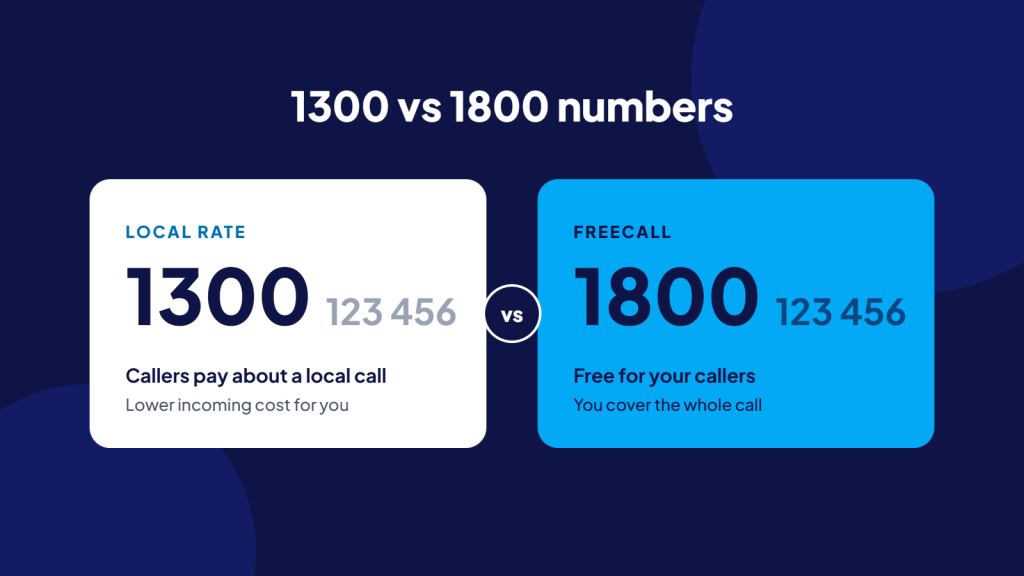
A 1300 number is a national “local rate” number: the caller pays roughly what a local call costs and your business pays the rest. An 1800 number is a freecall number: the caller pays nothing from a landline or Australian mobile and your business pays for the whole call. That difference in who pays is the main thing that separates them.
For your business, both work the same way on the bill. You pay a setup fee, a monthly fee and a per-minute charge for incoming calls, plus a one-off cost if you want a specific, memorable number. 1800 numbers usually cost the business more per call because you are covering the caller’s share too.
As a rule of thumb, choose 1800 when removing every barrier to calling matters most (sales and customer helplines), and 1300 when you want a single national number at a lower incoming call cost.
Key takeaways
- 1300 and 13 numbers are local rate: callers pay about the cost of a local call, and most mobile plans include these calls.
- 1800 numbers are free to call from landlines and, generally, from Australian mobiles. Your business pays for the whole call.
- Your costs are a setup fee, a monthly fee, incoming call charges and, optionally, the one-off cost of a smartnumber or phoneword.
- Neither number can usually be dialled from overseas, so add a local number if you have international callers.
- 13, 1300 and 1800 numbers can move with you to a new provider through porting.
What is a 1300 number (and how is it different from 13 and 1800)?
1300, 13 and 1800 numbers are inbound numbers. They aren’t tied to a physical line or a location. Instead, your provider points them at phones you already have: a phone system, desk phones, landlines or mobiles. You can change where calls go without changing the number you advertise.
The ACMA’s guide to phone numbers sets out the formats:
- 1300 numbers are 10 digits (1300 xxx xxx) and are “local rate” numbers.
- 13 numbers are 6 digits (13 xx xx) and are also local rate. With at most 10,000 possible combinations, they are scarce and typically cost much more to obtain than a 1300 number.
- 1800 numbers are 10 digits (1800 xxx xxx) and are freephone numbers. A small set of 7-digit 180 numbers also exists, but you are unlikely to be offered one.
People often call all of these “1300 numbers” or “smartnumbers”, but strictly a smartnumber is a particularly memorable 13, 1300 or 1800 number sold by the ACMA. More on that below.
What does a 1300 or 1800 number cost?
Prices vary between providers, so here are the parts that make up the cost. Use them to compare offers line by line. For our current rates, see 1300 number pricing and 1800 number pricing.
- Setup fee. A one-off charge to issue the number and connect it to your phones.
- Monthly fee. The ongoing charge to keep the number active. Check what’s included, such as routing rules, reporting or voicemail.
- Incoming call charges. Your business pays a per-minute rate for every call answered on the number. 1800 rates are typically higher than 1300 rates, and some providers charge a different rate for calls that come from mobiles, so ask.
- Choosing a specific number. An ordinary number from your provider’s pool usually costs nothing extra. A memorable smartnumber or phoneword is bought separately from the ACMA for a one-off charge that depends on how desirable the number is.
- Porting. If you already have a 13, 1300 or 1800 number, there is usually a one-off fee to move it to a new provider.
Incoming call charges are the part that surprises people. On a busy 1800 line they can far outweigh the fixed fees, so estimate your call minutes before you decide.
Who pays what when someone calls?
With a 1300 or 13 number, the caller pays a fixed, local-call-like charge from a landline. From mobiles, the ACMA explains that telcos either include these calls in the plan or charge a fixed rate similar to a landline call. An industry guideline introduced in 2014 also asked mobile providers to offer “13-friendly” plans that count these calls within the plan’s included value.
With an 1800 number, calls are free from landlines. The major mobile networks have also made 1800 calls free since 1 July 2015. The ACMA still notes that some mobile providers may charge, so “free” is the norm rather than a guarantee.
| 1300 / 13 | 1800 | |
|---|---|---|
| Number format | 1300 xxx xxx, or 13 xx xx | 1800 xxx xxx |
| Caller pays (landline) | About the cost of a local call | Nothing |
| Caller pays (mobile) | Included in most plans, or charged like a standard call | Free on the major networks |
| Your business pays | Setup, monthly fee and part of each call | Setup, monthly fee and all of each call (higher per-minute rate) |
| Callable from overseas | Usually not | Usually not |
| Best suited to | A national presence at a lower incoming cost | Sales, enquiries and help lines where you want every call |
1300 vs 1800: which should you choose?
It comes down to how much each call is worth to you and how price-sensitive your callers are.
- Service businesses and franchises taking bookings nationally: a 1300 number gives one easy number for every state without paying for the whole call.
- Sales and lead generation: 1800 removes any hesitation about cost, which matters when every enquiry could be a sale.
- Customer support and help lines: 1800 is the considerate choice when people call you because something has gone wrong, especially for long calls.
- Local trades and single-location businesses: a local 02, 03, 07 or 08 number often does the job, costs less to run and signals that you’re nearby.
- Multi-site businesses: a 1300 or 1800 number can route callers to the right branch, so you advertise one number everywhere.
Plenty of businesses use more than one: an 1800 number on sales material, a 1300 number for general enquiries and a local number for overseas callers. You can compare all three on our business numbers page.
How are calls to a 1300 or 1800 number routed?
Because the number isn’t tied to a line, routing is where most of the value sits. Common options include:
- Time-based routing: calls go to the office during business hours and to an after-hours service, a mobile or voicemail at other times, including public holidays.
- Geographic routing: the caller’s location decides which branch or state office answers, so a customer in Perth reaches the Perth team.
- IVR menus: “Press 1 for sales, 2 for support” sends callers to the right team before anyone picks up.
- Queues and ring groups: calls ring several people at once or wait in line until someone is free.
- Mobiles and apps: calls ring staff on their mobile or a softphone app, wherever they are.
- Voicemail to email: missed calls arrive in an inbox as a recording.
Not every provider offers every option, so check which features come with the number and which need a phone system behind it.
Choosing and owning your number
Standard numbers, smartnumbers and phonewords
Most businesses take a standard number from their provider. If you want something memorable, such as a repeating pattern or a phoneword (a number that spells a word using the letters on the keypad), you buy it through the ACMA’s smartnumbers system. Available numbers are listed with a price in the ACMA’s online numbering system, you pay to secure the one you want, and buying a smartnumber gives you “enhanced rights of use” that let you keep, license or trade the number.
Buying the number doesn’t connect it. As the ACMA puts it, you then approach a service provider to supply a service on it. So a smartnumber has two sets of costs: the one-off charge to the ACMA, and the usual setup, monthly and call charges from your provider.
Phoneword tips
- Keep the word short and unambiguous. If people have to ask how to spell it, it isn’t helping.
- Print the digits as well as the word. Letters are fiddly to dial on a mobile, and many people copy the number straight from your website.
Can you take your number with you?
Yes. Under the Telecommunications Numbering Plan, freephone and local rate numbers are portable, so a 13, 1300 or 1800 number can move to a new provider. Your new provider starts the process with your authority, and calls keep reaching you on the old service until the number switches over. Keep your account with the old provider open until the move is complete. Our number porting team handles the paperwork for both simple and complex ports.
What about callers from overseas?
13, 1300 and 1800 numbers generally can’t be dialled from outside Australia, and you can’t rely on international access being available. If you have customers, suppliers or staff overseas, add a local number and publish it in international format (for example, +61 7 followed by the number). It can ring the same phones as your national number.
Common mistakes to avoid
- Comparing monthly fees only. Incoming call charges usually matter more, especially on 1800.
- Printing the number before routing is tested. Call it from a mobile and a landline, during and after hours, before it goes on signage.
- No after-hours plan. An unanswered national number looks worse than a local one. At least send calls to voicemail or a mobile.
- Pointing the number at one person’s mobile. If that person is sick, on leave or leaves the business, calls go nowhere.
- Forgetting overseas callers. A website that only lists an 1800 number shuts them out.
- Losing track of who holds the number. Keep a record of the account and, for smartnumbers, your ACMA login, so you can port it later.
How CloudLine does it
We supply 1300, 1800 and local numbers and connect them to our Hosted PBX, so every number gets the same tools: greetings and IVR menus, queues and ring groups, business hours and public-holiday routing, and voicemail to email with a text transcript. Calls can ring desk phones, landlines or the mobile app, where your team answers with the business number showing, not their personal mobile.
If you already have a number, we’ll port it for you. And because we’re part of an ISO 27001 certified IT company, we can check the network and firewall your phones rely on before you switch.
Frequently asked questions
Is a 1300 number free to call?
No. Callers pay a fixed charge from a landline, about the cost of a local call. From a mobile, most plans include 13 and 1300 calls in the plan’s allowance. If you want calls to be free for the caller, choose an 1800 number.
Do you need a phone system to have a 1300 or 1800 number?
No. A 1300 or 1800 number can ring an existing landline or mobile. A phone system adds queues, IVR menus, call recording and reporting, which become useful once more than a couple of people answer calls.
Can a business have both a 1300 and an 1800 number?
Yes. Many businesses use an 1800 number for sales or support and a 1300 or local number for everything else. Each can have its own routing, so you can also see which number people are calling.
How much does a smartnumber or phoneword cost?
It depends on how memorable the number is. The ACMA sets the price and lists available numbers in its online numbering system. You then pay your provider’s usual setup, monthly and call charges on top to connect it.
Does a 1300 number change if you switch providers?
No. 13, 1300 and 1800 numbers are portable, so you keep the number and your new provider arranges the move.
Not sure whether 1300, 1800 or a local number suits you? See current pricing on our 1300 and 1800 pages, ask for a quote, or call us on 1800 256 830.