
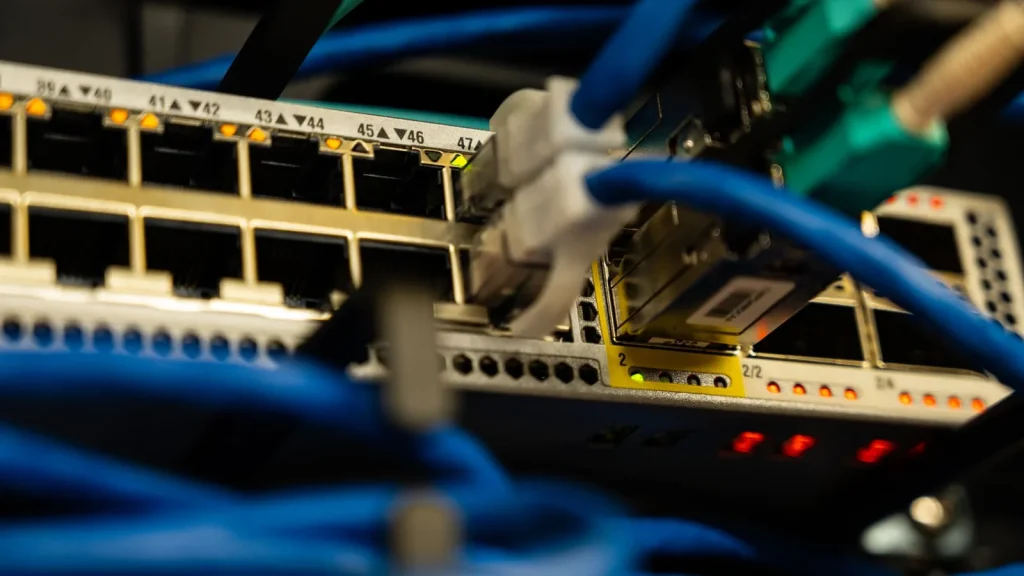
A SIP trunk is a phone line delivered over your internet or data connection to a phone system you already own. It connects your on-premise PBX to the public phone network, so you can make and receive calls on your business numbers without copper or ISDN lines. SIP trunking is the service; a SIP provider is the company that supplies it.
Capacity is sold in channels. Each channel carries one call at a time, so a trunk with ten channels can handle ten calls at once. You pay for the channels you need and can usually add more without new cabling.
Key takeaways
- A SIP trunk provides the lines for a phone system you own; a hosted PBX replaces the phone system itself.
- One channel carries one simultaneous call. A rough starting point is one channel for every three staff in a typical office, and one per agent in a call centre.
- You need a SIP-compatible IP PBX or a gateway, a stable internet connection and a router or firewall set up for voice.
- When choosing a SIP provider, look at clear pricing, call quality, number porting, toll-fraud protection, easy scaling and local technical support.
What is a SIP trunk?
SIP stands for Session Initiation Protocol. It is an open standard, defined by the Internet Engineering Task Force in RFC 3261, for setting up, changing and ending sessions such as phone calls over an IP network. Almost every modern business phone system and IP phone uses it.
A trunk is an old telephony term for a bundle of lines shared by many users. In the copper days, a business might have had an ISDN service with ten or twenty lines running into its PBX. A SIP trunk does the same job virtually: your PBX registers with the SIP provider over the internet, and calls pass between your system and the phone network through that connection.
Your phone numbers are attached to the trunk. Incoming calls to those numbers arrive at your PBX, which routes them to extensions, queues or menus in the usual way. Outgoing calls leave through the trunk and show your business number.
What is a SIP channel, and how many do you need?
A channel is capacity for one concurrent call, inbound or outbound. If all your channels are in use, the next caller hears a busy signal or is sent wherever your PBX sends overflow calls. Too few channels and customers cannot get through; too many and you pay for capacity you never use.
Our rule of thumb is roughly one channel for every three staff in a typical office, because not everyone is on the phone at once. In a call centre, where agents spend most of the day on calls, plan for one channel per agent.
| Business | Starting point |
|---|---|
| Office with 6 staff | About 2 channels |
| Office with 15 staff | About 5 channels |
| Office with 30 staff | About 10 channels |
| Call centre with 12 agents | 12 channels, plus headroom for callers waiting in the queue |
Then adjust for how your business actually works. You may need more channels if:
- Your PBX forwards calls to mobiles, because a forwarded call usually uses two channels (one in, one out)
- Callers wait in queues or menus, since each waiting caller occupies a channel
- You have predictable peaks, such as Monday mornings or end-of-month billing
- Staff make outbound calling campaigns or long conference calls
Your PBX call logs are the best evidence. Look at the highest number of simultaneous calls over a few busy weeks and add some headroom.
SIP trunk vs hosted PBX: which do you need?
Both are VoIP. The difference is who owns and runs the phone system. With SIP trunking you keep your own PBX and buy the lines. With a hosted PBX, the provider runs the phone system in the cloud and the lines come with it. Our guide to what a hosted PBX is explains that option in more detail.
| SIP trunking | Hosted PBX | |
|---|---|---|
| What you buy | Lines (channels) and numbers for your own PBX | A complete phone system with lines, numbers, phones and apps |
| Phone system | You own and maintain it | The provider hosts and maintains it |
| How it is priced | Usually by channel, plus calls depending on the plan | Usually per user, plus calls depending on the plan |
| Features | Whatever your PBX provides | Whatever the hosted platform provides |
| Who configures call flow | You or your PBX maintainer | You, through the provider’s portal, or the provider |
| Best for | Businesses with a capable PBX, in-house IT or a call centre setup they want to keep | Businesses replacing an old system or starting fresh |
If your PBX is near the end of its life, compare the cost of replacing it with moving to a hosted system. If it still has years left and does what you need, SIP trunks let you keep that investment.
What equipment do you need for SIP trunking?
- A SIP-compatible phone system. Most IP PBXs support SIP trunks. Older systems built for ISDN or analogue lines can often be connected using a VoIP gateway, which converts between SIP and the older interface.
- A stable internet connection. Voice does not need much bandwidth per call, but it adds up across channels, and the exact amount depends on the codec your system uses. A connection dedicated to voice, or one with voice prioritised, gives the most consistent results.
- A router or firewall set up for voice. SIP needs the right ports and rules. A router feature called SIP ALG often breaks SIP calls by rewriting them; our guide to SIP ALG and how to turn it off explains why. Quality of service (QoS) settings should give voice traffic priority.
Why Australian businesses moved from ISDN and PSTN to SIP
For years, business phone systems connected to the network through copper PSTN lines or ISDN. The NBN switched off most of that. In NBN fixed-line areas, copper phone services are disconnected around 18 months after an area is declared ready for service, and Telstra Wholesale’s exit notice set 31 May 2022 as the ISDN exit date in NBN fixed-line areas, with extra time for NBN wireless and satellite areas.
That left businesses with a working PBX two choices: connect it to SIP trunks, or replace it with a hosted system. SIP trunking became the standard way to keep an existing PBX running over the NBN or another business internet service.
What to look for in a SIP trunk provider
SIP trunks can look alike on paper. These six points separate a good SIP provider from one that causes problems later.
1. Clear pricing, published up front
You should be able to see channel plans, call rates, number fees, porting and any setup charges before you talk to sales. Check which call types are included, how calls to mobiles and 13/1300 numbers are charged, and the contract length. Hidden fees and vague “call for pricing” plans make it hard to compare SIP line providers fairly.
2. Call quality and the network behind it
Ask which carrier network carries your calls, where the provider’s infrastructure is, and how it handles an outage on its side. Ask which codecs it supports, too, and whether it can help you test call quality from your site before you commit.
3. Number porting and coverage
ACMA confirms you can usually keep your number when you change telcos, including local, 1300 and 1800 numbers. A good SIP service handles the port for you, supports complex ports of number ranges, and can issue new local numbers in any Australian area when you need them.
4. Security, including toll-fraud protection
Toll fraud happens when criminals get into a phone system and use it to make expensive calls, often to international or premium numbers. Optus’s PBX fraud guide warns that the business is responsible for the security of its own phone system, and fraudulent calls can leave the business with the bill. Ask what the provider does to help: international call barring you can turn on, spending alerts or limits, strong credentials, and monitoring for unusual call patterns.
5. Easy scaling of channels
Your channel needs will change as you hire, open sites or run campaigns. Look for a provider that lets you add or remove channels quickly, without new hardware or a new contract, and that makes it simple to move between plans.
6. Local technical support that understands networks
Most SIP problems, such as one-way audio, dropped calls or failed registrations, turn out to be firewall, NAT or router issues. A provider with a technical team that understands networks, not just phone lines, can find the cause instead of pointing at your IT provider. Local support hours that match your business hours help too.
How CloudLine’s SIP trunking works
CloudLine SIP trunking offers plans from a single channel up to 32, with untimed local and national calls over a Tier 1 Australian carrier network. It works with most SIP-compatible IP PBXs and gateways, and we publish current plans and call rates on the page.
Because CloudLine is part of an ISO 27001 certified IT company, we can check your router and firewall before you go live, turn off settings that interfere with SIP, and help secure your system against toll fraud. We also handle number porting, including complex ports.
Frequently asked questions
Is a SIP trunk the same as VoIP?
A SIP trunk is one type of VoIP service. VoIP is the general term for voice over IP networks; a SIP trunk is a specific way of connecting a phone system to the phone network using VoIP.
Can I use SIP trunks with my old ISDN phone system?
Often, yes. Many older PBXs can be connected to SIP trunks through a VoIP gateway that converts between SIP and ISDN. If the system is very old or unsupported, compare the cost of a gateway and ongoing maintenance with moving to a hosted PBX.
How many channels does a small office need?
A starting point is about one channel for every three staff, then adjust for forwarding to mobiles, queues and busy periods. Your call logs show your real peak.
What happens if my internet goes down?
Calls cannot reach your PBX over the trunk while your connection is down. Ask your provider whether incoming calls can be diverted to another number or mobile during an outage, and consider a backup connection if phones are critical to your business.
Do SIP trunks work on the NBN?
Yes. SIP trunks run over any suitable business internet connection, including the NBN. The connection needs enough spare upload capacity for your busiest times, and your router should be set up for voice.
If you have a phone system you want to keep, see current plans on our SIP trunking page, request a quote for the channels you need, or call us on 1800 256 830.